



Most leaders believe pay is the lever that keeps people accountable. Tie raises to individual performance, and people will work harder. Untie them, and standards will slip. That belief feels especially strong in operations where timing matters—where a late start cascades into lost output, overtime, and frustration. But what if the very tools meant to enforce accountability are quietly making the system worse?
W. Edwards Deming spent much of his career challenging a deeply held management assumption: that individual performance can be measured, ranked, and rewarded in a way that reliably improves results. His critique was not philosophical. It was grounded in how real work actually happens.
Deming was blunt about the damage caused by this assumption. He wrote that “evaluation of performance, merit rating, or annual review” is a management disease—one that builds fear and undermines cooperation instead of improving results.
A deadly disease: evaluation of performance, merit rating, or annual review
— W. Edwards Deming
In most organizations, especially those that operate in shifts, results are produced by systems—by schedules, handoffs, training, equipment readiness, and staffing decisions. When leaders focus compensation on judging individuals instead of improving systems, fear replaces learning, and supervisors become referees instead of leaders.
This tension is often dismissed as a white‑collar concern. But the opposite is true. The more tightly coupled the work, the less individual performance explains outcomes—and the more management decisions shape results.
That reality plays out clearly at Sunrise Acres, a large egg farm running multiple barns across three shifts.
When measurement isn’t enough
Sunrise Acres depends on precision. Every shift change affects feeding schedules, sanitation routines, and downstream quality. When crews start late, the consequences ripple through the day.
Miguel, the operations manager, is exhausted by the problem. “We track everything,” he says. “Names. Minutes late. Warnings. We even tie raises to attendance—and it still doesn’t stick.”
Late starts keep happening.

Sarah, the farm’s general manager, doesn’t argue with him. “What if the problem isn’t the people?” she asks. “What if it’s the way the day starts?”
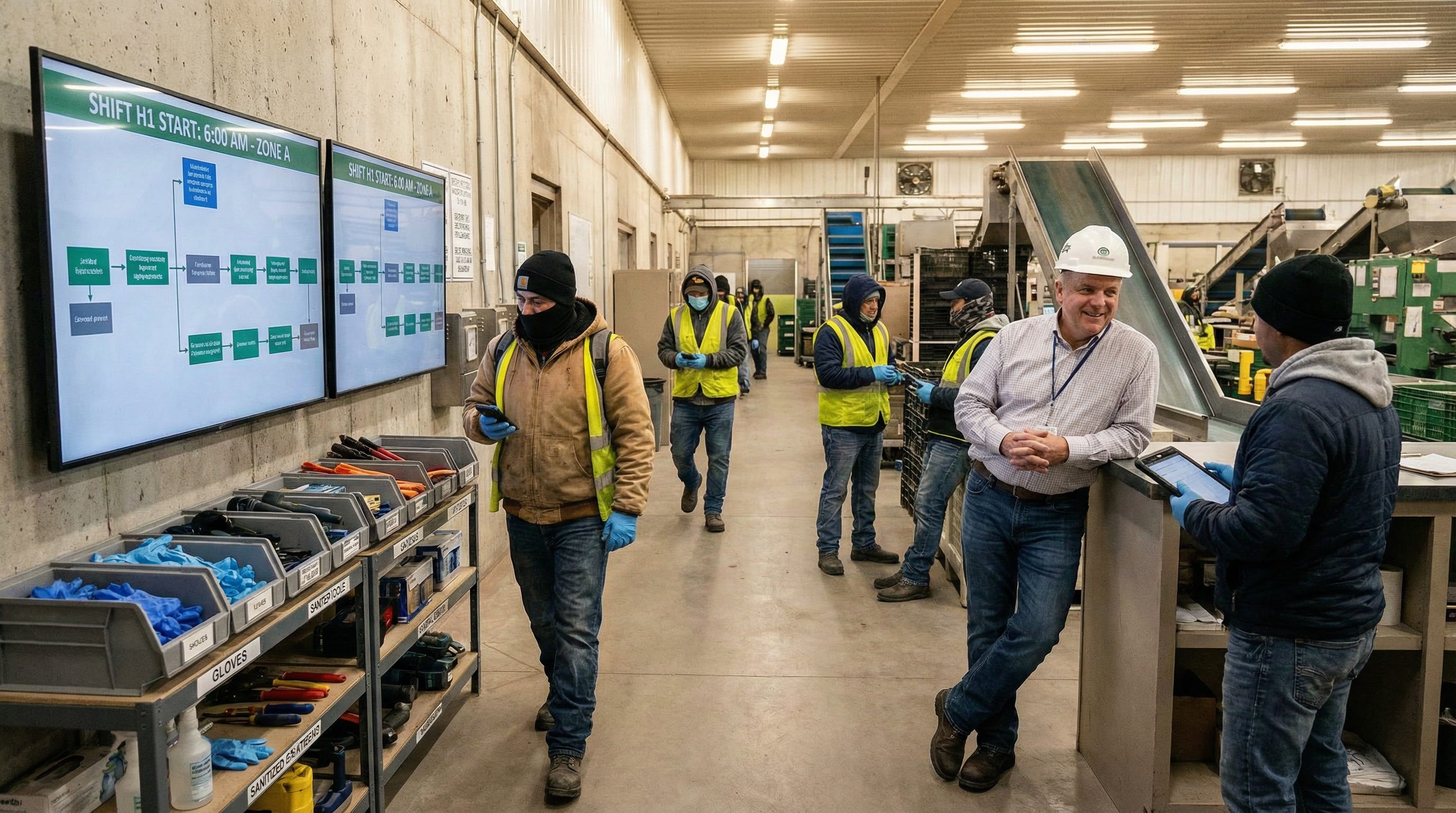
Together, they walk the process from parking lot to first task. The issues surface quickly. The time clock is deep inside the barn. Protective equipment is stored in multiple locations. New hires aren’t clear on relief coverage. Buses arrive with built‑in variability. And supervisors are stretched thin at shift change.
No one would blame a single hen for a flock problem. Seeing the system end to end makes it clear that punctuality has been treated like a character trait, even though the system makes being on time unnecessarily hard.
They make practical changes: moving the clock closer to the entrance, pre‑staging PPE kits, adding a short overlap for handoffs, and using visual start‑time cues. A bilingual lead helps direct arrivals. Attendance improves almost immediately.
One employee, Rosa, is still late. Instead of issuing another warning, Miguel follows Sarah’s lead and starts a conversation. Rosa explains that her childcare opens at the same time her shift begins. A small schedule adjustment and cross‑training resolve the issue completely.
What becomes clear is that most lateness was common‑cause—built into the system. A few cases required individual action, but only after the system barriers were removed.
When raises come due, Miguel hesitates. “So… no merit scores?”
Sarah is explicit. Base pay is set by role and market. Raises come through skill blocks—what people are trained and qualified to do. Any shared upside is tied to farm‑level performance. Attendance expectations remain firm, and willful noncompliance is addressed directly. What they abandon is the fiction that a yearly rating caused punctuality.
Deming warned that “evaluation of performance, merit rating, or annual review” builds fear and rivalry while demolishing teamwork. He also cautioned that it is “unfair, as it ascribes to the people in a group differences that may be caused totally by the system that they work in.” At Sunrise Acres, supervisors stop keeping secret tallies and start removing barriers in the work. Training accelerates. Turnover slows. Late starts drop—and so do the hidden costs that came with them.
[Performance-based pay] is unfair, as it ascribes to the people in a group differences that may be caused totally by the system that they work in.
— W. Edwards Deming
Where managers go wrong
Most leaders don’t rely on merit pay because they enjoy ranking people. They do it because it feels like control—especially when schedules slip or output falters.
Deming warned that this instinct leads managers to confuse numbers with knowledge. When results vary, rating people feels decisive, even when the variation comes from the system itself.
When attendance problems show up, the instinct is to tighten enforcement, add documentation, or raise the stakes. But in tightly coupled systems, this approach confuses accountability with judgment. It treats variation created by schedules, transportation, training gaps, and process design as individual failure.
We tell ourselves that without performance‑based pay, standards will collapse. In practice, the opposite often happens. Fear drives people to protect themselves rather than surface problems. Supervisors spend their time policing instead of improving the work.
This doesn’t mean ignoring behavior. Deming never argued for permissiveness. He argued against blaming people for problems built into the system. True accountability comes after leaders have done their part: designing work so success is possible, and making expectations clear and achievable.
[Performance-based pay] nourishes short-term performance, annihilates long-term planning, builds fear, demolishes teamwork, nourishes rivalry and politics.
— W. Edwards Deming
Actionable Takeaways
Stepping back from merit pay does not mean stepping back from leadership. It means redirecting leadership toward the work itself.
Separate pay from judgment. Set base pay by role and market. Use clear skill progression for raises—certifications, cross‑training, demonstrated capability. If you share gains, do it at the system level so people improve together.
Design attendance into the process. Map the start of a shift the same way you would any critical operation. Remove friction, clarify handoffs, and make expectations visible. Measure patterns and causes, not personalities.
Be clear about accountability. When behavior remains willful after support and system fixes, address it directly and promptly. Don’t outsource leadership to a rating form.
When pay decisions are predictable and fair, they stop dominating attention. That frees leaders to focus on what actually improves results—building capable people and reliable systems.
All anyone asks for is a chance to work with pride.
— W. Edwards Deming
Closing
The question was never whether people should be accountable. The question was whether pay and ratings are the right tools to achieve it.
Deming argued that pay systems should be predictable and fair, writing that “the people of a group that form a system will all be subject to the company’s formula for raises in pay.” That idea runs counter to merit pay—but it aligns closely with how real systems actually work.
At Sunrise Acres, removing merit pay didn’t weaken standards. It strengthened them. By focusing on system design instead of individual judgment, leaders created conditions where showing up on time was no longer a battle to be fought, but a normal part of professional work.
When systems are designed well, people don’t need to be threatened into compliance. They can take pride in doing the work right—because the work finally works for them.


